[ Project sentinel ]■
A Pilot Opportunity to Build Canada’s Sovereign Public Safety Sensing Capability
Canada’s public safety and security agencies increasingly require persistent, real-time situational awareness across vast and remote regions—from wildfire monitoring to border security and search-and-rescue operations. However, many sensing and surveillance capabilities remain episodic, fragmented across departments, or constrained by long procurement timelines.
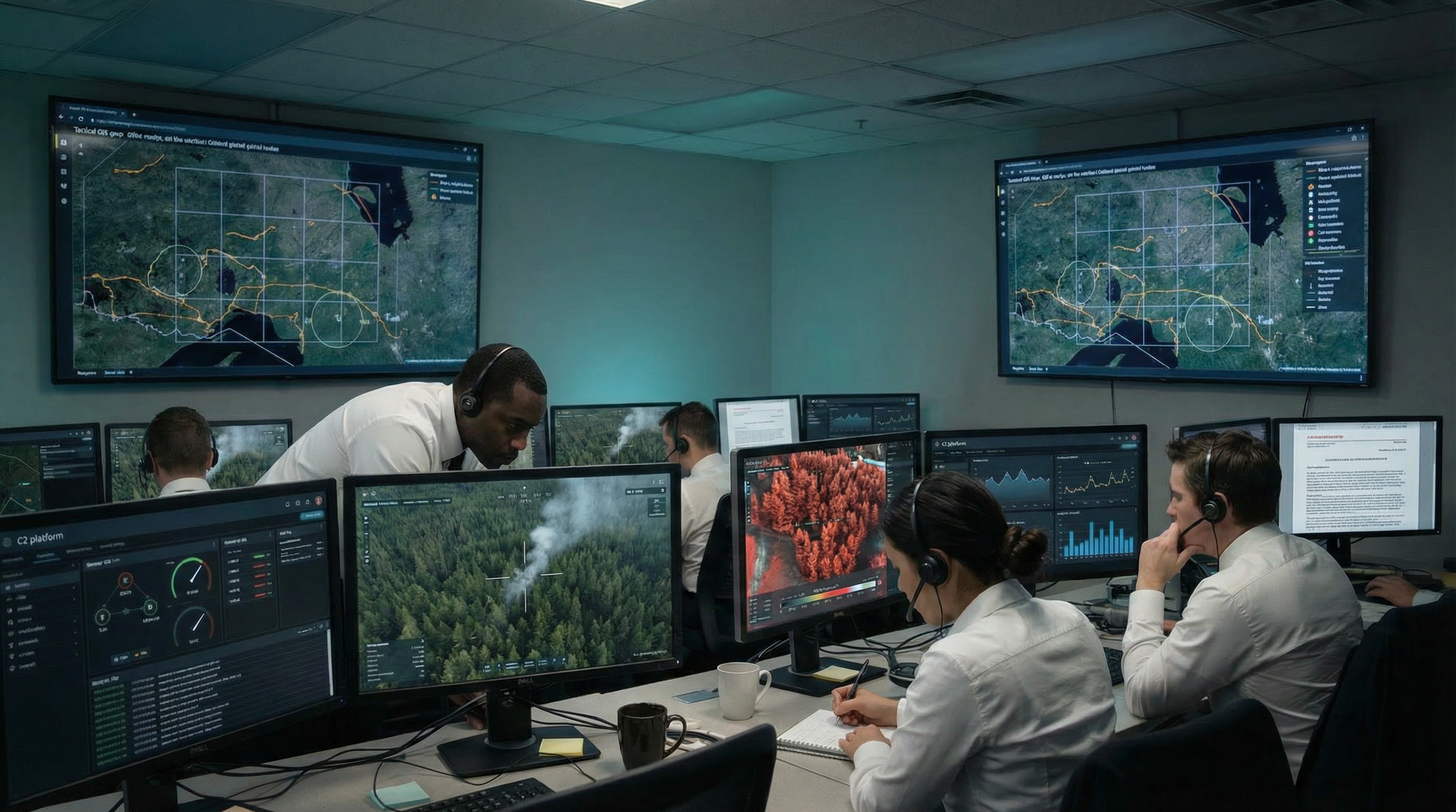
Project Sentinel, developed by National Public Safety Corp. (NPS), introduces a Canadian-owned and Veteran-led model for persistent aerial sensing and operational intelligence delivered as a service to government. The system combines long-range unmanned sensing platforms, secure data infrastructure, and operational intelligence analysis—allowing Canada to begin building sovereign unmanned sensing infrastructure supported by operational AI, real-world data, and regulatory learning.
This approach allows the Government of Canada to test and scale new sensing infrastructure quickly through pilot deployments while maintaining policy oversight, regulatory authority, and data governance.
[ Why this matters now ]■
Building sovereign Canadian AI capability for public safety
Project Sentinel will develop in-house public safety AI models, trained on operational sensing data generated through national deployments. These models will continuously improve detection, analysis, and response across missions such as wildfire monitoring, border security, and disaster response.
Enabling sovereign unmanned capability in Canadian civilian airspace
Pilot deployments generate the operational data, safety validation, and regulatory learning required to enable long-range unmanned flight in civilian Canadian airspace—helping establish a durable Canadian capability in autonomous sensing infrastructure.
Strengthening national situational awareness across Canada’s vast geography
Persistent sensing infrastructure can augment federal and provincial capabilities in wildfire detection, border monitoring, environmental surveillance, and search-and-rescue operations.
Creating high-skill jobs in regional communities across the country
The initiative supports high-skill employment in aviation operations, software engineering, AI systems, and intelligence analysis—many roles well suited to Canadian Armed Forces Veterans transitioning to civilian careers.